

Comprehensive Investment Guide for Beginners in NEPSE
If you have ever wondered how to start investing in Nepal but did not know where to begin, you are not alone. Thousands of young Nepalis are asking the same question every day. The good news is that you do not need a lot of money or a finance degree to get started. Whether you are a student, a salaried professional, or a small business owner, this beginner’s guide to investing in Nepal will walk you through everything from understanding what investing means to opening your first DEMAT account and buying your first stock on NEPSE.
This Nepal investment guide is designed specifically for beginners in 2026. By the end, you will know exactly where to invest money in Nepal, how much you need to start, and which mistakes to avoid.
What Does Investing Mean?
This Investing Guide will help you understand the essentials of making informed investment decisions.
Investing means putting your money into an asset such as stocks, mutual funds, or property with the expectation that it will grow in value over time. In simple terms, you make your money work for you instead of letting it sit idle.
Saving vs. Investing at a Glance
| Features | Saving | Investing |
| Risk | Very Low | Moderate-High |
| Return | 4-6% FD Interest | 10-20% + (NEPSE) |
| Goal | Safety & Liquidity | Wealth Growth |
| Nepal Example | Bank Fixed Deposit | NEPSE Stocks / SIP |
If you put Rs. 1,00,000 in a bank Fixed Deposit (FD) at 6% interest per year, you earn Rs. 6,000 after one year. But if the same Rs. 1,00,000 is invested in quality stocks on NEPSE and grows at 15% per year, you earn Rs. 15,000 — more than double. That is the power of investing in Nepal.
Why Investing is Important in Nepal: An Investing Guide

Many Nepalis keep their savings in a bank account and consider it enough. But here is the reality: keeping money only in the bank can actually make you poorer over time. Here is why:
Inflation is Eating Your Money
Nepal’s average annual inflation rate has hovered between 6% and 8% in recent years. This means that if your savings earn only 4–5% interest in a bank, your real purchasing power is actually shrinking. A product that costs Rs. 1,000 today may cost Rs. 1,070 next year. If your savings do not grow at least as fast as inflation, you lose money in real terms.
Fixed Deposit Returns Are Too Low
Fixed Deposits (FDs) in Nepali commercial banks currently offer 6–8% annual interest. While safe, this is often barely enough to beat inflation — and after tax, the real return is even lower. The NEPSE index, by contrast, has delivered multi-year compound returns that significantly outpace FD rates for patient investors.
Youth Are Waking Up to Investing in Nepal
Youth interest in the NEPSE stock market and SIP (Systematic Investment Plans) has exploded in recent years. With smartphone access and digital broker platforms, beginner investing in Nepal has never been more accessible. There has been a massive rise in new DEMAT account registrations, especially among people aged 18–35.
Best Investment Options in Nepal
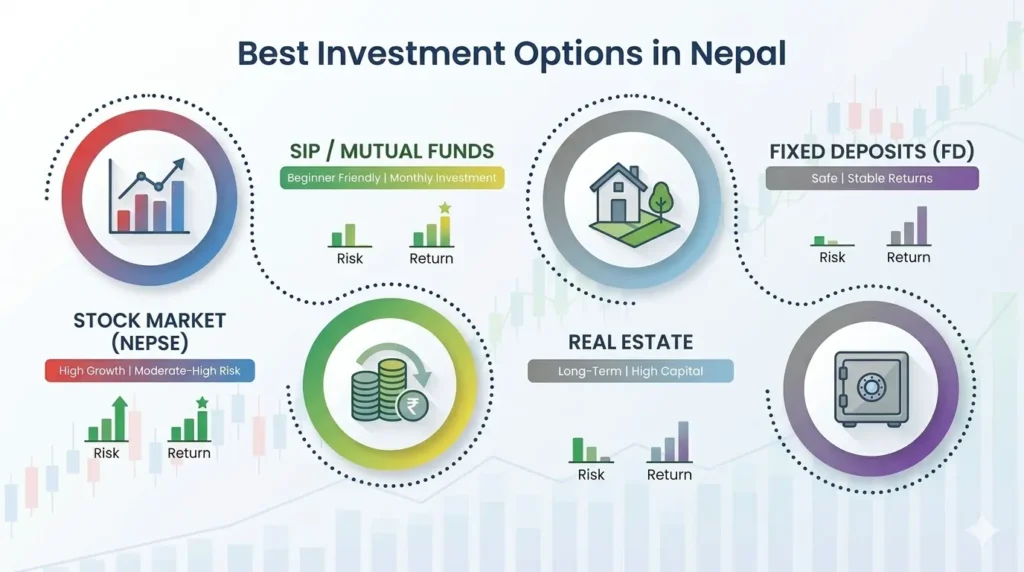
There are several investment options in Nepal available for beginners in 2026. Each comes with its own risk level, return potential, and minimum investment requirement. Here is a clear breakdown:
Stock Market (NEPSE) – Best for Growth
NEPSE (Nepal Stock Exchange) is Nepal’s official stock market where shares of publicly listed companies are bought and sold. This is the most popular investment platform in Nepal.
- Minimum investment: As low as Rs. 100 per share (IPO applications start at Rs. 1,000)
- Potential return: 10–25%+ annually (varies by stock and market conditions)
- Risk: Moderate to High, stock prices go up and down
- Best for: Investors willing to learn and take calculated risks
Beginner tip: Start with blue-chip stocks (large, stable companies like banks and hydropower)
SIP / Mutual Funds – Best for Beginners
SIP in Nepal (Systematic Investment Plan) is one of the most beginner-friendly investment options available. Instead of investing a lump sum, you invest a fixed amount every month — as little as Rs. 500–1,000 — into a mutual fund managed by professional fund managers.
- Minimum monthly investment: Rs. 500–1,000
- Managed by SEBON-registered fund managers
- Reduces risk through rupee-cost averaging
- Best for: Salaried individuals who want to automate wealth-building
- Popular funds: Nabil Equity Fund, NIBL Pragati Fund, and others
Fixed Deposits (FD) — Safest but Lowest Returns
Fixed Deposits are the most traditional form of investment in Nepal. You deposit money in a bank for a fixed term (3 months to 5 years) and earn a guaranteed interest rate.
- Drawback: Returns barely beat inflation after tax
- Current FD rates in Nepal: 6–8% per year
- Risk: Very Low — your principal is safe
- Best for: Emergency funds or risk-averse investors
Real Estate — Long-Term, High Capital Required
Real estate has traditionally been one of the most popular investments in Nepal — especially in Kathmandu Valley, Pokhara, and other growing cities. Land values have appreciated significantly over the past decade.
- Best for: Investors with significant capital and a 10+ year horizon
- Minimum capital needed: Rs. 10–50 lakhs or more
- Long-term return: High, especially in urban areas
- Risk: Low liquidity (hard to sell quickly)
How to Start Investing in Nepal (Step-by-Step Guide)
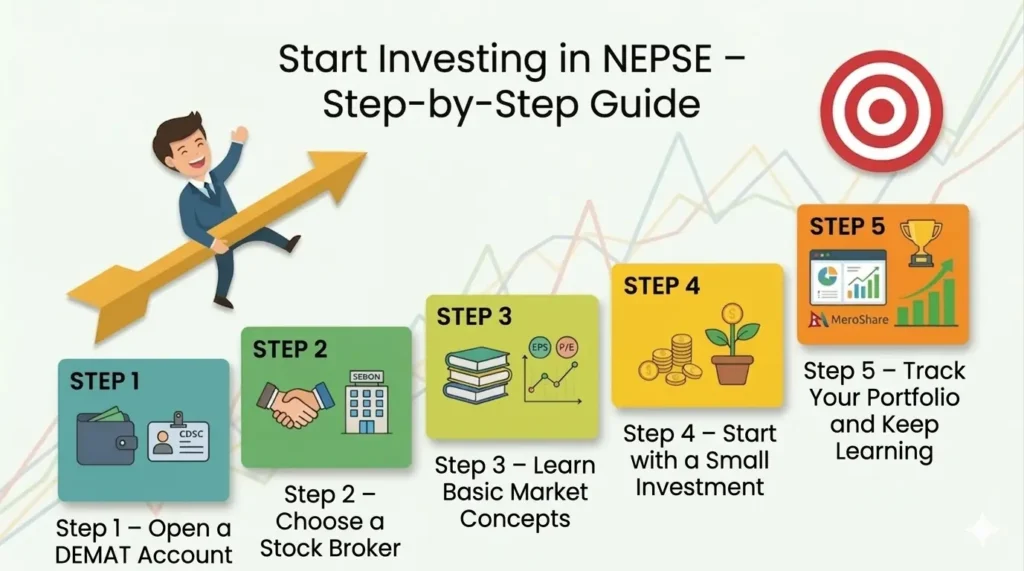
Now that you know your investment options in Nepal, here is exactly how to invest in Nepal step by step, from a complete beginner to your first investment.
Open a DEMAT Account
A DEMAT (Dematerialized) account is your digital wallet for stocks in Nepal. It is mandatory for trading on NEPSE. Without it, you cannot buy or sell shares.
- Cost: Free to open, a small annual maintenance fee may apply
- Visit any licensed broker’s office or their online portal
- Bring your citizenship card, passport-size photo, and bank account details
- Fill in the CDS (Central Depository System) form
- Your DEMAT account will be linked to your bank account automatically
- Time required: 1–3 working days
Your DEMAT account is linked to the CDSC (CDS and Clearing Limited) system of Nepal. This is where all your shares are stored digitally.
Choose a Stock Broker
To buy and sell stocks on NEPSE, you need a SEBON-licensed broker. In Nepal, brokers are numbered (e.g., Broker No. 21 — Sunrise Capital). You can choose any broker registered with SEBON.
- Commission rate: Approximately 0.40% per transaction (regulated by SEBON)
- Check SEBON’s official list of licensed brokers at sebon.gov.np
- Compare broker services: online trading platform, customer support, commission rates
- Popular online brokers in 2026: MeroShare, NMB Lagani App, and others
Learn Basic Market Concepts
Before putting any money into NEPSE, spend at least 2–4 weeks learning the basics. This investment in knowledge will save you from costly mistakes.
- Use the MeroShare portal to track IPOs and company announcements
- Understand what a share is and how dividends work
- Learn to read a company’s financial report (EPS, P/E ratio, book value)
- Understand NEPSE index movement and market cycles
- Follow finance-focused YouTube channels and blogs based in Nepal
Resources: MeroShare.com, SEBON, Nepal Stock Exchange (nepalstock.com). Spending 30 minutes daily reading about investing can transform your financial future.
Start with a Small Investment
The biggest mistake beginners make is waiting until they have ‘enough’ money. The truth is, you can start investing in Nepal with as little as Rs. 1,000–5,000. Starting small allows you to learn without risking large sums.
- Allocate only 10–20% of your income to investing when starting out
- Apply for IPOs: minimum Rs. 1,000 (10 units × Rs. 100 per share)
- Buy shares from the secondary market: even 1–5 shares of affordable companies
- Start a monthly SIP: Rs. 500–1,000 per month in a mutual fund
- Rule: Never invest money you cannot afford to lose in the short term
Track Your Portfolio and Keep Learning
Investing is not a one-time event. It is a lifelong habit. Once you have made your first investment, the real journey begins.
- Stay updated with Nepal Rastra Bank (NRB) monetary policy updates, which affect stock prices
- Review your portfolio monthly — not daily (avoid emotional decisions)
- Use MeroShare to track your holdings, dividends, and IPO allotments
- Read annual reports of companies you invest in
- Gradually increase your investment amount as your income grows
The best investors in Nepal are not the ones who trade every day but the ones who invest consistently and patiently over the years.
Money You Need to Start Investing in Nepal?
One of the biggest myths in Nepal is that investing is only for the rich. This is completely false. Here is the truth about how much you actually need:
| Investment Type | Minimum Amount (NPR) |
| IPO Application | Rs. 1,000 |
| Monthly SIP | Rs. 500 |
| Secondary Market | Rs. 1,000 – 5,000 |
| Fix Deposit | Rs. 5,000 – 10,000 |
| Real Estate | Rs. 10,00,000+ |
Yes — you can start investing in Nepal with as little as Rs. 1,000. The key is not how much you start with, but that you start. Even Rs. 1,000 invested monthly in a SIP or IPO builds the habit and knowledge base you need. As your income grows, you can scale up your investments.
Common Myth: “I will start investing when I have Rs. 5 lakhs saved.” Reality: Start today with Rs. 1,000. The biggest advantage in investing is time, not money.
Common Mistakes Beginners Make When Investing in Nepal

Learning from others’ mistakes is free. Here are the most common beginner investing mistakes in Nepal — and how to avoid them:
❌ Mistake 1: Following Rumors and Tips
In Nepal’s investment circles, stock tips spread like wildfire on Facebook, WhatsApp, and TikTok. Buying a stock just because someone said ‘it will go up tomorrow’ is not investing it is gambling. Always research before you invest.
❌ Mistake 2: Not Doing Any Research
Many beginners invest in companies they have never heard of. Before buying any shares, check the company’s EPS, P/E ratio, dividend history, and management quality. This data is available for free on nepalstock.com and MeroShare.
❌ Mistake 3: Panic Selling
NEPSE is volatile. Prices go up and down. When the market falls 10–15%, many beginners panic and sell their shares at a loss. This is one of the costliest mistakes. Patient investors who hold through downturns have historically recovered and grown their wealth.
❌ Mistake 4: Expecting Fast Profits
Investing is not a get-rich-quick scheme. People who made fortunes in NEPSE did so over many years, not days. If someone promises you 100% return in a month, it is likely a scam.
❌ Mistake 5: Putting All Money in One Stock
Never invest all your money in a single company. Diversify across different sectors, such as banking, hydropower, insurance, and microfinance, to reduce your overall risk.
Tips for Smart Investing in Nepal

Here are proven principles that successful investors in Nepal follow:
✅ 1. Think Long-Term
The most successful investors in Nepal hold their investments for 5–10+ years. Short-term trading is difficult, stressful, and often unprofitable for beginners. Set a goal, invest consistently, and give your money time to grow.
✅ 2. Diversify Your Portfolio
Spread your investments across different sectors and asset types. A simple beginner portfolio in Nepal might include: 50% in banking stocks, 25% in hydropower, 15% in a mutual fund SIP, and 10% in a Fixed Deposit as a safety net.
✅ 3. Invest consistently, use the SIP Approach
Even if the market is down, keep investing your monthly amount. This strategy called rupee-cost averaging, means you buy more shares when prices are low and fewer when prices are high, reducing your average cost over time.
✅ 4. Keep Learning Regularly
The best investment you can make is in your own financial education. Read the business news, follow NRB announcements, understand how government policy affects markets, and study successful Nepali investors’ strategies.
✅ 5. Only Invest Money You Do Not Need Urgently
Always keep 3–6 months of living expenses in an easily accessible savings account before investing. This emergency fund ensures you never have to sell your investments at a bad time.
🎯 Smart investing in Nepal is simple: start early, invest regularly, diversify, and be patient. You do not need to be a genius; you need consistency.
Conclusion: Start Your Investment Journey in Nepal Today
Learning how to start investing in Nepal does not have to be complicated or intimidating. The most important step is simply the first one — and you can take it today, even with just Rs. 1,000.
Here is what to remember from this Nepal investment guide:
- Investing is different from saving — it grows your wealth faster than inflation
- The best investment options in Nepal for beginners are NEPSE stocks and SIP mutual funds
- You can start with as little as Rs. 500–1,000
- Open a DEMAT account, choose a broker, learn the basics, and invest consistently
- Avoid common mistakes: no panic selling, no rumor-based decisions, no get-rich-quick expectations
- The key ingredients are time, consistency, and patience
Nepal’s capital market is growing, more companies are listing, and digital investing tools are making it easier than ever. The question is not whether you should invest — it is whether you can afford not to.
Start investing in Nepal today – even with little money. The best time to start was yesterday. The second-best time is right now.
Can I start investing in Nepal with little money?
Yes, absolutely. You can start investing in Nepal with as little as Rs. 1,000. Apply for an IPO with Rs. 1,000, or start a monthly SIP mutual fund with Rs. 500. The amount is less important than the habit of starting.
Is NEPSE safe for beginners in 2026?
NEPSE carries market risk — prices can go up and down. However, it is a regulated market overseen by SEBON (Securities Board of Nepal). Beginners can manage risk by starting small, diversifying, and investing for the long term rather than trading daily.
What is the best investment in Nepal for beginners?
For most beginners in Nepal, a combination of SIP in mutual funds (for safety and automation) and IPO applications (for potential listing gains) is the best starting point. As you learn, you can begin buying individual stocks on NEPSE.
What is a DEMAT account, and why do I need it in Nepal?
A DEMAT account is a digital account that holds your shares electronically. In Nepal, it is issued through the CDSC (CDS and Clearing Limited) system and is mandatory for trading stocks on NEPSE. Without a DEMAT account, you cannot invest in the stock market.
What is SIP in Nepal and how does it work?
SIP (Systematic Investment Plan) allows you to invest a fixed amount — as low as Rs. 500 — every month in a mutual fund. Your money is pooled with other investors and managed by a professional fund manager. Over time, through compounding and rupee-cost averaging, your wealth grows steadily.

Leave a Reply