
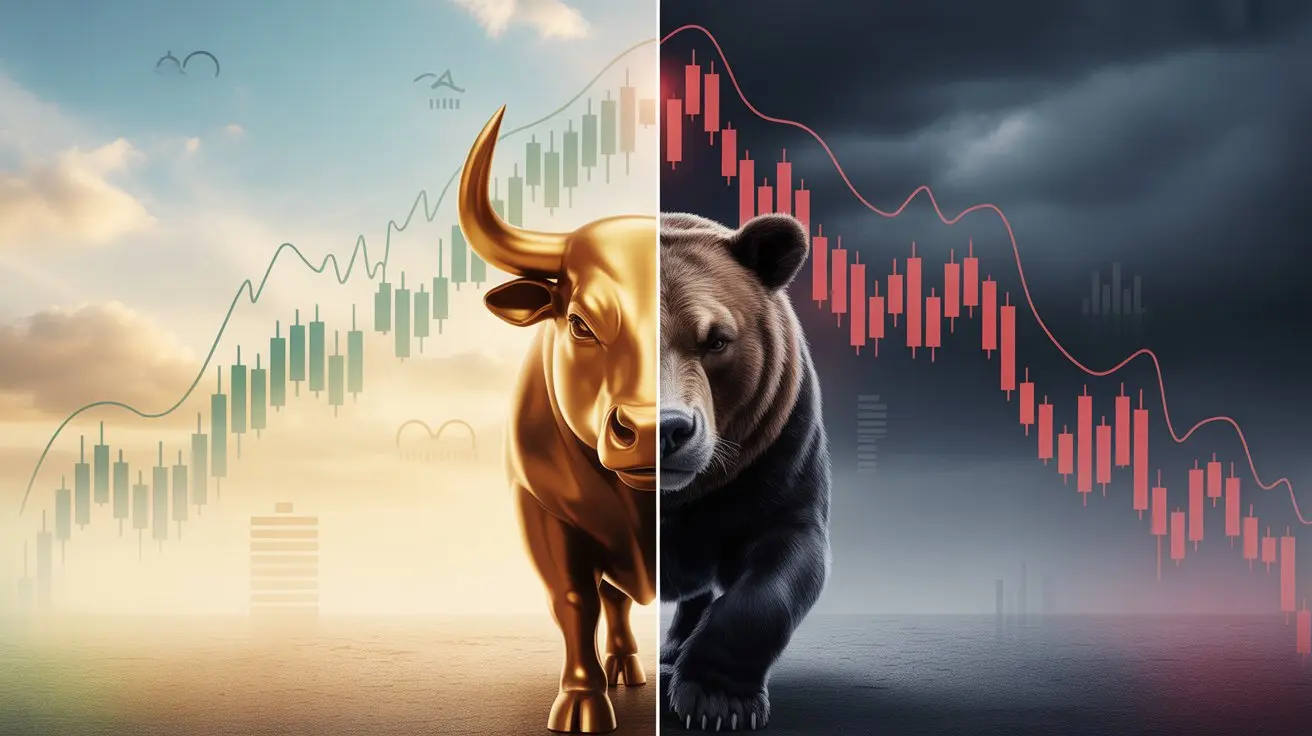
If you witnessed the NEPSE index rally past 3,000 points in 2021, you experienced a strong bull market, where rising confidence, high liquidity, and aggressive buying pushed stock prices upward. In contrast, when NEPSE dropped below 1,900, it reflected a typical bear market, marked by fear, selling pressure, and declining valuations. This clearly shows the reality of Bull market vs Bear market in NEPSE Nepal, where market cycles can be sharp and driven by investor sentiment. In a bull market, even weak stocks may rise on momentum, while in a bear market, even fundamentally strong companies can see their prices decline. Understanding whether you are in a bull market or bear market is critical, as most investors lose money not because the market is unpredictable, but because they fail to adapt to changing conditions.
Every investor will face both phases, and success depends on adjusting strategy instead of reacting emotionally. During a bull market, investors should focus on riding trends, holding quality stocks, and avoiding unnecessary panic selling. In a bear market, the priority shifts to capital protection, selective buying, and patience, as strong opportunities emerge at lower valuations. Key signals such as market trends, liquidity, and interest rate changes help identify these phases in NEPSE Nepal. Historically, markets move in cycles, and disciplined investors use this to their advantage, maximizing gains in a bull market and accumulating assets in a bear market. Mastering bull markets and bear markets is essential for long-term success, helping investors protect and grow their wealth in any market condition.
What Is a Bull Market?
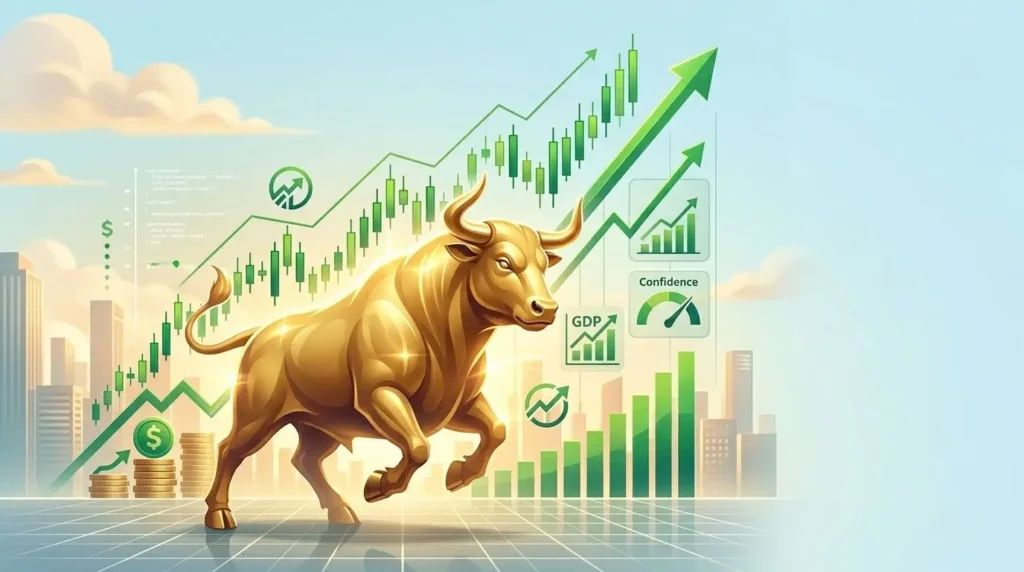
A bull market is a sustained period where stock prices rise 20% or more from recent lows, accompanied by growing investor confidence, improving economic conditions, and accelerating market participation.
In NEPSE, bull runs don’t just rise; they explode. All four major bull cycles delivered index gains of 100% to 530% from their lows. More importantly, every bull market in NEPSE history has surpassed the previous cycle’s peak, a pattern that makes the long-term case for Nepali equities undeniable.
What Is a Bear Market?
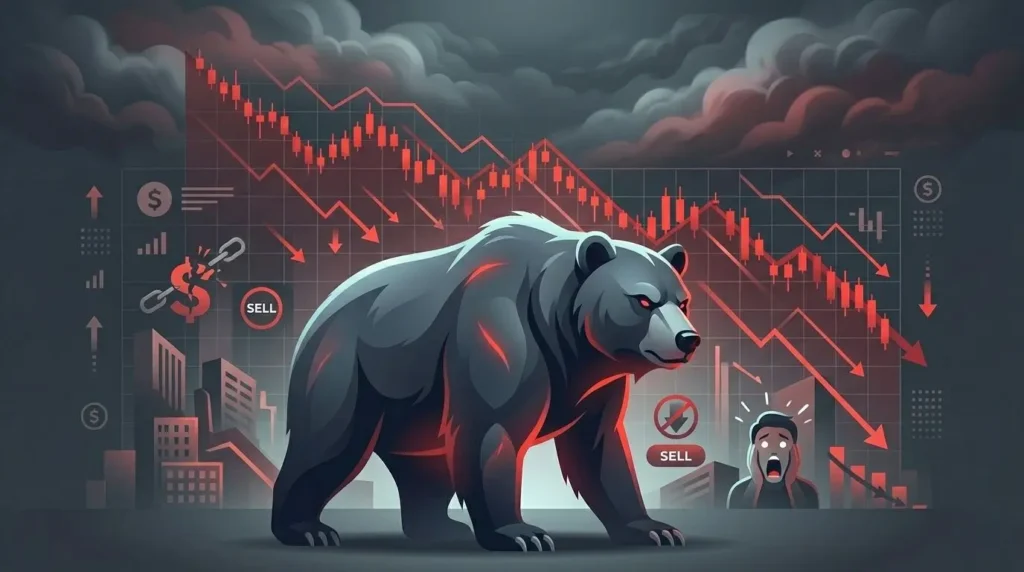
A bear market is a sustained decline of 20% or more from recent highs, lasting two months or longer. Fear replaces optimism. Liquidity dries up. Margin calls cascade.
NEPSE’s bear runs are particularly brutal because Nepal’s market is dominated by retail investors — many of whom invest on borrowed margin. When prices fall, leveraged investors are forced to sell, accelerating the decline in a vicious loop.
Bull Market vs Bear Market: Key Differences at a Glance
| Factor | Bull Market | Bear Market |
| Direction | Rising 20%+ from lows | Falling 20%+ from highs |
| NEPSE Example | 1,099 → 3,198 (2019–2021, +188%) | 3,198 → 1,806 (2021–2022, -44%) |
| Global Example | S&P 500: 2009–2020 (+400%) | S&P 500: 2008 crash (-50%) |
| Investor Emotion | Optimism, FOMO, Greed | Fear, Panic, Despair |
| NRB Policy | Accommodative, low rates | Tightening, rate hikes |
| Banking Liquidity | High — free lending | Low — credit squeeze |
| Daily NEPSE Turnover | NPR 10–21.6 billion | Below NPR 1–3 billion |
| Avg. Duration (NEPSE) | 20–52 months | 10–34 months |
| Best Strategy | Growth — BFIs, hydro, IPOs | DCA, bonds, watchlist building |
History of Bull and Bear Market Cycles
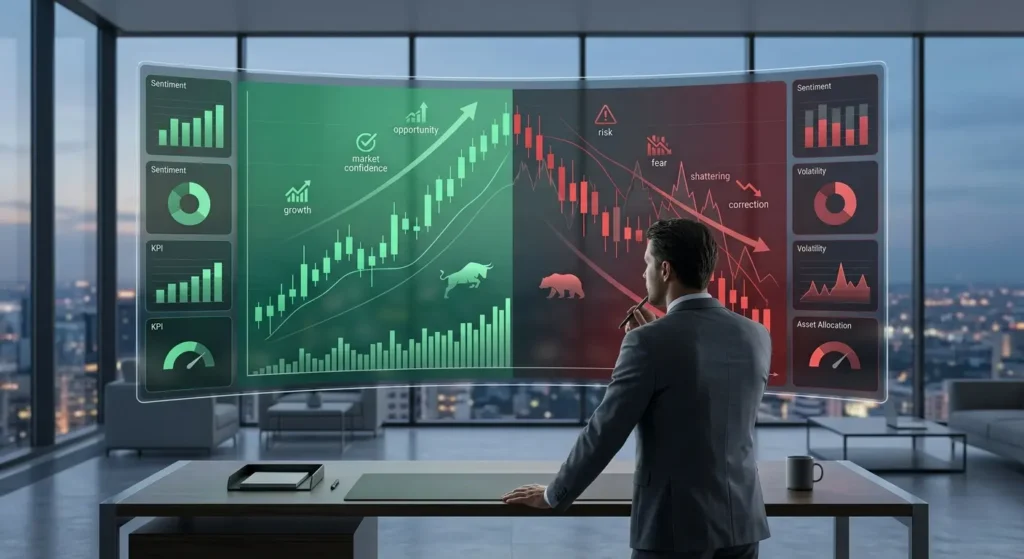
Since NEPSE began trading in 1994, Nepal’s stock market has completed four full bull-and-bear cycles. Each cycle has revealed important patterns that help investors understand what drives markets in Nepal:
| Market Cycle | Peak & Downfall | Gains & Loss | Key Drivers |
| Bull 1 (1997–2000) | 100 → 545 points | +445% | Investor enthusiasm, economic hope |
| Bull 2 (2004–2008) | 195 → 1,175 points | +502% | Banking sector expansion, credit growth |
| Bull 3 (2012–2016) | 300 → 1,888 points | +530% | Post-earthquake recovery, BFI recapitalization |
| Bull 4 (2019–2021) | 1,099 → 3,198 points | +188% | COVID lockdown liquidity, low interest rates, new investors |
| Bear 1 (2000–2004) | 545 → 195 points | -64% | Civil war, economic instability, loss of confidence |
| Bear 2 (2008–2012) | 1,175 → 298 points | -75% | Global financial crisis, local economic slowdown |
| Bear 3 (2016–2019) | 1,888 → 1,099 points | -42% | Rising interest rates, NRB tightening, liquidity crunch |
| Bear 4 (2021–2022) | 3,198 → 1,806 points | -44% | COVID lockdown liquidity, low interest rates, and new investors |
One of the most striking patterns in NEPSE’s history is that every bull market has surpassed the previous cycle’s peak. From 545 in 2000 to 1,175 in 2008, then 1,888 in 2016, and finally the all-time high of 3,198 in 2021 — the long-term trajectory has been upward, despite the brutal intermediate bear markets. This is the most powerful argument for long-term investing in NEPSE.
Global Parallels of Bull Market and Bear Markets
2008–2009 Global Financial Crisis — S&P 500: –50%
U.S. housing markets imploded. The S&P 500 collapsed from 1,565 (October 2007) to 666 (March 2009) — a 57% wipeout. Banks, mortgage lenders, and investment giants failed across America and Europe simultaneously. The shockwave reached every emerging market, including NEPSE. Global risk appetite evaporated, capital fled, and Nepal’s own bear market followed.
What came after an 11-year bull market, the longest in U.S. history, is the definitive proof that patient investors are systematically rewarded. The investors who sold in March 2009 locked in losses. Those who held, or bought, built generational wealth.
India’s Nifty 50 Correction (2018–2019)
India’s benchmark index dropped 15–20% from its January 2018 peak, pressured by surging crude oil prices, a depreciating rupee, and the U.S. Federal Reserve draining global liquidity through rate hikes. This hits Nepal harder than any Wall Street crisis. Nepal’s rupee is pegged to the Indian rupee. That single fact means Indian monetary conditions are Nepali monetary conditions. When India’s liquidity tightens, Nepal’s tightens automatically. Add trade dependency and remittance flows, and every Indian market shock is a Nepali market shock, transmitted through multiple channels at once.
The Post-COVID Recovery (2020–2021)- How Global Stimulus Fueled NEPSE’s Bull Run
The fastest bear market in recorded history, global indices shed 30–40% in a matter of weeks in March 2020. Then: unprecedented central bank stimulus, near-zero interest rates globally, and vaccine-driven optimism triggered a historic reversal. The S&P 500 recovered all losses within five months.
Global liquidity flooded Nepal’s banking system. With interest rates on savings products at historic lows, retail investors poured capital into NEPSE, chasing returns. The result was NEPSE’s own explosive bull run in 2020–2021, a direct downstream effect of decisions made in Washington and Frankfurt.
NEPSE does not move in isolation. It is downstream of global monetary policy. Understanding why the market moves is the difference between reacting and positioning.
Signs of a Bull Market in NEPSE
- Index breaks key resistance on high volume — sustained above the breakout level for multiple sessions
- Daily turnover climbs from NPR 1–3B toward NPR 10B+ — signals growing participation
- NRB signals monetary easing or cuts the policy rate — historically the most reliable bull trigger in Nepal
- BFI stocks rise on strong earnings and dividend announcements
- New DEMAT account openings accelerate sharply — mass retail entry is a classic late-bull signal
- IPO oversubscription rates surge — investors have capital and confidence to deploy
- Tea shops, social media, and mainstream media are dominated by stock talk — euphoria has arrived
Signs of a Bear Market in NEPSE
- NRB raises interest rates or caps margin lending — the July 2021 margin loan cap (NPR 40M per bank, NPR 120M across banks) directly triggered Bear 4
- Interbank rates spike — signals system-wide liquidity crunch
- NEPSE breaks below key support levels with high volume — failed recovery attempts confirm the trend
- Daily turnover collapses — from NPR 21.6B at the 2021 peak to below NPR 1B in the bear phase
- Fixed deposit rates rise significantly — capital exits equities for safer returns
- Large BFI stocks fall on weak earnings or dividend cuts
- Political instability intensifies — regulatory vacuums add uncertainty
Bull & Bear Market Psychology
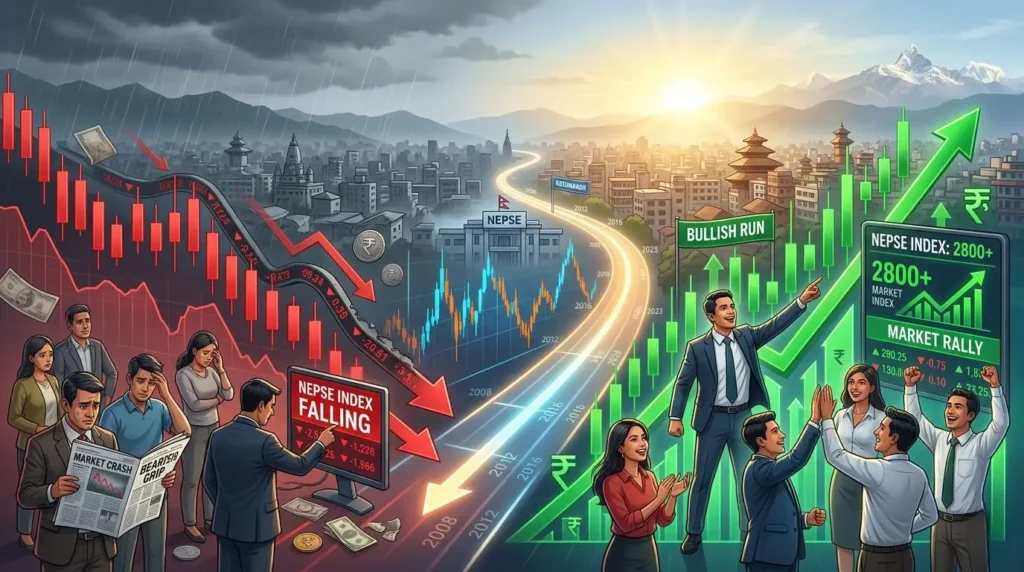
The FOMO-Driven Bull
As NEPSE approached 3,000 in 2021, social media overflowed with extraordinary profit stories. Students, shopkeepers, and farmers opened DEMAT accounts and borrowed money to buy shares near the all-time high. This is how late-stage bull euphoria always ends with the most recent entrants holding the most risk.
The Panic-and-Blame Bear
When NEPSE crashed in 2021–2022, investor protests were organized in Kathmandu. Finance ministers faced public pressure. Legal cases were filed against regulators. This emotional, political response to market loss is a recurring feature of NEPSE bear markets and marks capitulation, not recovery.
The Disciplined Investor’s Advantage
Warren Buffett’s principle translates directly to Kathmandu: be fearful when others are greedy, and greedy when others are fearful. In NEPSE terms: when everyone is talking about stocks, check your valuations. When everyone is filing protests, check your watchlist.
Conclusion

NEPSE has rewarded patient, disciplined investors across three decades and four complete market cycles. From 100 points at inception to 3,198 at its all-time high, Nepal’s capital market has an unmistakable long-term trajectory — one built atop genuinely brutal intermediate crashes.
Bull markets and bear markets are not events to fear or celebrate. They are the operating environment of investing. Understanding what causes them, how to recognize them in real time, and how to position your portfolio across both is what separates wealth builders from loss stories in Nepal’s market.
The principles are simple. The execution — investing systematically through fear, avoiding margin in euphoria, and ignoring the noise in both directions — is where most investors fail. Master the execution, and NEPSE’s next cycle becomes an opportunity rather than a threat.
Is it better to invest during a bull or bear market in NEPSE?
The best long-term returns come from buying during bear markets and holding through bull cycles. Investors who purchased quality stocks when NEPSE was near 1,099 (2019 low) and held to the 2021 peak saw gains of 150–300%+. Since timing the exact bottom is impossible, systematic investment through both phases outperforms most market-timing strategies.
How do NEPSE beginners survive a bear market?
Five steps: (1) Maintain a 3–6 month emergency fund before investing. (2) Only invest money you won’t need for 3–5 years. (3) Continue investing small, fixed amounts monthly in fundamentally strong stocks. (4) Focus on quarterly earnings and dividend track records — not social media. (5) Eliminate or reduce margin debt immediately.
Can you make money in a NEPSE bear market?
Yes. Three realistic approaches: apply for IPOs (typically priced more conservatively during bear markets), buy quality BFI stocks trading below book value (price-to-book below 1.0 is a value signal), and park capital in NRB bonds or savings certificates for fixed returns while positioning for recovery.
Should Nepali investors stop buying during a market crash?
Generally, no. Investors who stopped buying during the 2021–2022 crash missed the recovery that brought NEPSE back above 2,700–2,800 by 2024–2025. The exception: if you are using margin or borrowed money, stop and pay down debt first.
How often do bull and bear markets occur in NEPSE?
Approximately every 5–7 years, based on NEPSE’s complete cycle history since 1994. Bull phases last 20–52 months; bear phases last 10–34 months. NEPSE cycles are less frequent than global markets but more extreme — making long-term discipline even more critical.
What sectors lead NEPSE bull markets?
BFI (banking and financial institutions) stocks consistently lead the early and middle phases. The hydropower and insurance sectors typically accelerate in the later stages. Microfinance and development banks often outperform near the cycle peak.
Leave a Reply