

The Rise of AI in Financial Decision-Making
Somewhere right now, an algorithm is scanning thousands of market signals, executing a trade in microseconds, and rebalancing a portfolio — with zero human involvement. This is not a future scenario. AI in investing is already managing trillions of dollars in global assets, and its influence is accelerating in ways most people have not yet noticed.
What began as a tool for elite hedge funds has quietly become a force in everyday financial life. From smartphone budgeting apps to fully autonomous robo-advisors, AI is changing how individuals and institutions alike think about, manage, and grow money. Whether you are building your first investment account or overseeing a complex portfolio, AI is increasingly part of the equation.
In this guide, we break down exactly how AI in investing works, what tools are available, the real benefits and risks, and how beginners can start using AI finance tools today.
What Is AI in Investing?
AI in investing refers to the use of artificial intelligence systems — including machine learning, natural language processing, and predictive analytics — to analyze financial data, predict market trends, and automate investment decisions.
Unlike traditional software that follows a fixed set of rules, AI systems learn. They are trained on vast financial datasets — decades of stock prices, earnings reports, economic indicators, and even social media sentiment — and improve their predictions as they process new data.
Core components of AI in investing
Predictive algorithms: Mathematical models trained to forecast price movements, credit risk, and market trends based on historical patterns.
Market sentiment analysis: Natural language processing (NLP) systems that scan millions of news articles, earnings call transcripts, and social posts to gauge investor mood.
Automated decision systems: Algorithmic engines that execute buy and sell orders based on pre-defined signals — often in milliseconds.
How AI Is Changing Investing Globally

The AI investment revolution is not confined to Wall Street. In the United States and Europe, AI-driven hedge funds and algorithmic trading already account for a substantial share of daily market volume. In Asia — particularly China, Japan, and South Korea — financial institutions have rapidly integrated AI into risk management, loan underwriting, and portfolio construction.
In emerging economies including India and Nepal, AI-powered fintech platforms are democratizing access to financial services. Mobile-first robo-advisors and AI credit scoring tools are reaching populations that have historically been excluded from the formal financial system — a development with profound implications for global wealth distribution.
Who is using AI in investing today?
- Hedge funds like Renaissance Technologies and Two Sigma have built their entire investment philosophy around machine learning and quantitative strategies.
- Retail platforms like Betterment and Wealthfront bring AI-powered portfolio management to everyday investors for a fraction of traditional advisory fees.
- Banks and lenders use AI for fraud detection, credit risk assessment, and regulatory compliance.
AI in Trading: The Evolution of Trading AI
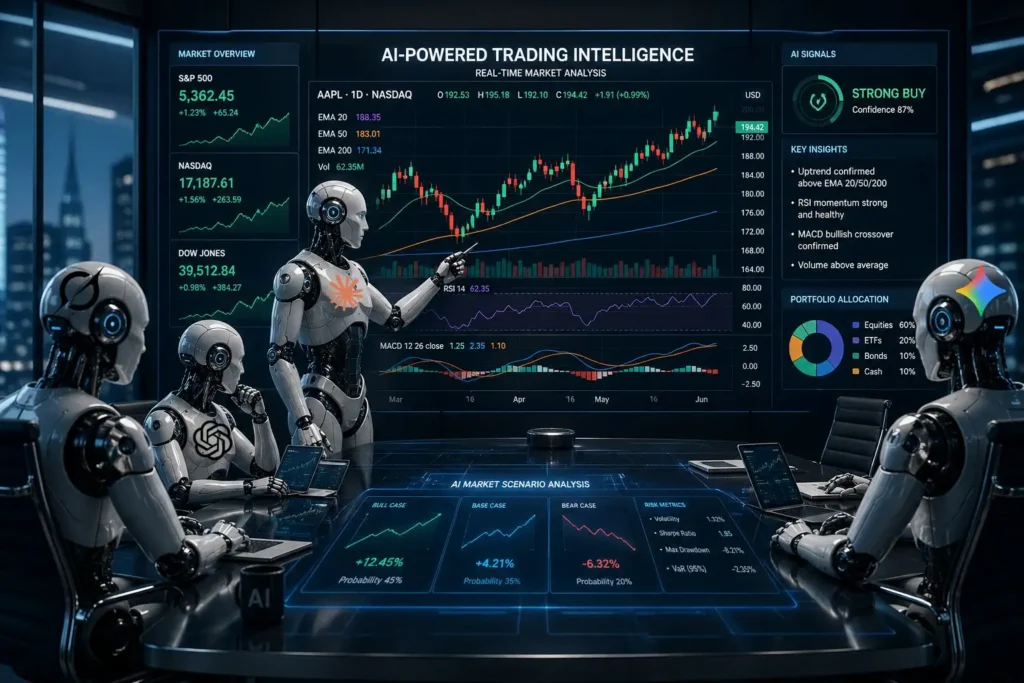
Trading AI refers to systems that use artificial intelligence to analyze markets and execute trades autonomously. These systems can monitor hundreds of assets simultaneously, process real-time data feeds, and respond to market events far faster than any human trader can.
The speed advantage is especially significant in high-frequency trading, where price discrepancies between markets exist for fractions of a second. AI systems are engineered to exploit these fleeting opportunities with precision that human traders simply cannot match.
Key benefits of trading AI
- Speed and accuracy: Executes trades in microseconds, eliminating human delay and minimizing slippage.
- Emotion-free discipline: AI follows its strategy regardless of market fear or euphoria — eliminating the panic selling and FOMO that destroy retail investor returns.
- Real-time data processing: Simultaneously analyzes live price feeds, earnings releases, news wires, and macro indicators to make informed decisions.
- Backtesting capability: AI strategies can be validated against decades of historical data before any real capital is committed.
Risks of automated trading systems

The 2010 Flash Crash — in which the Dow Jones plunged nearly 1,000 points in minutes — was partly triggered by algorithmic trading systems reacting to one another in a cascade. When many AI systems follow similar strategies, they can amplify volatility rather than reduce it. Black-swan events also expose a fundamental weakness: AI models trained on historical data cannot anticipate scenarios without precedent.
AI Finance Tools You Should Know
The AI finance tools landscape has matured rapidly. Here are the most impactful categories and platforms available today:
Robo-advisors
- Betterment: Goal-based AI investing with automatic rebalancing and tax-loss harvesting.
- Wealthfront: Comprehensive AI financial planning including portfolio management, cash optimization, and personalized savings paths.
- Schwab Intelligent Portfolios: Zero-management-fee robo-advisor using AI to build diversified ETF portfolios.
Stock research and prediction tools
- Kavout: Machine learning platform that scores stocks using a proprietary “Kai Score” derived from vast alternative data sets.
- Danelfin: AI-driven stock analysis with explainable signals across fundamental, technical, and sentiment data.
Personal finance AI apps
- Credit Karma: AI-driven credit monitoring with personalized recommendations for improving credit scores.
- YNAB (You Need A Budget): Uses ML to categorize transactions and generate personalized budget recommendations.
- Cleo: AI finance chatbot that tracks spending, sets savings goals, and provides plain-language financial coaching.
Benefits of AI in Investing and Finance

- Better decisions through data: AI processes more information, faster, and more objectively than any human team — leading to more consistent, evidence-based outcomes.
- Elimination of emotional bias: Panic selling and overconfident buying are among the most costly investor behaviors. AI executes strategy without hesitation or second-guessing.
- Democratized access: AI has brought sophisticated portfolio management and financial advice to people who could never afford a traditional wealth manager.
- Automation and time savings: Rebalancing, tax optimization, and dividend reinvestment happen automatically — freeing investors to focus on their larger financial goals.
- Enhanced risk management: AI continuously monitors portfolio exposures and market conditions, adjusting positions in real time to stay within target risk parameters.
Risks and Limitations of AI in Investing
- Market unpredictability: No AI model can fully anticipate geopolitical events, central bank surprises, or human sentiment shifts. Black-swan events regularly humble even the most sophisticated algorithms.
- Data dependency: Garbage in, garbage out. AI models are only as reliable as the data used to train them. Poor or biased data leads to flawed predictions.
- Algorithm bias: AI systems trained on historical data can perpetuate and amplify existing biases — including discriminatory lending patterns in credit scoring models.
- Cybersecurity exposure: AI-driven financial systems are high-value targets. A successful attack on an algorithmic trading platform or robo-advisor could result in catastrophic losses.
- Over-automation risk: When large amounts of capital follow similar AI strategies, markets become vulnerable to cascading failures and flash crashes.
How Beginners Can Start Using AI in Investing
You do not need a finance degree or a large portfolio to benefit from AI finance tools. Here is a practical starting framework:
- Start small and scale: Even $50–$100 per month into a robo-advisor account is a meaningful starting point. Consistency matters more than the initial amount.
- Start with a robo-advisor: Platforms like Betterment or Acorns require no investment knowledge. Answer a short questionnaire and the AI builds and manages your portfolio automatically.
- Use an AI budgeting app: Install YNAB or Cleo to get a clear picture of your spending before you start investing. Understanding your cash flow is the foundation of any investment strategy.
- Learn the basics alongside the tools: AI works best when you understand what it is doing. Spend time learning core concepts like diversification, compound growth, and expense ratios.
- Avoid chasing predictions: No AI can predict the market with certainty. Use AI tools to inform disciplined, long-term decisions — not to time the market.
Conclusion
AI in investing has moved from concept to core infrastructure. It powers the robo-advisor rebalancing your retirement account, the fraud detection protecting your bank transactions, and the algorithmic systems executing millions of institutional trades every day. The technology is no longer optional for those who want to manage money effectively — it is increasingly the baseline.
The opportunities are real: better decisions, lower costs, greater access, and disciplined automation. But so are the risks: over-reliance on systems that can fail, data biases baked into algorithms, and volatility amplified by herd-like AI behavior.
The most important principle remains timeless: AI is a powerful tool, not a replacement for financial intelligence. The investors who benefit most are those who combine the computational power of machine learning with the wisdom of sound, long-term financial principles.
Whether you are just opening your first investment account or managing a sophisticated portfolio, the question today is not whether to use AI — it is how to use it wisely.
What is AI in investing?
AI in investing refers to the use of artificial intelligence — including machine learning and predictive analytics — to analyze financial data, identify investment opportunities, manage risk, and automate portfolio management and trading decisions.
Is AI good for trading?
Yes, with important caveats. AI offers significant advantages in speed, consistency, and data processing. However, AI trading systems can amplify market volatility and fail in black-swan events. The best results combine AI tools with human oversight and a long-term investment mindset.
What are the best AI finance tools for beginners?
For beginners, robo-advisors like Betterment, Wealthfront, and Acorns offer the most accessible entry point. For budgeting, YNAB and Cleo are excellent AI-powered options. These tools require no prior financial knowledge and guide users step by step.
Can beginners use AI for investing?
Absolutely. Many AI investing platforms are specifically designed for beginners. Robo-advisors handle portfolio construction, rebalancing, and tax optimization automatically. Starting with small amounts and focusing on long-term goals is the recommended approach.
Will AI replace financial advisors?
AI is unlikely to fully replace human advisors for complex financial planning, estate strategies, and major life decisions. The likely future is a hybrid model: AI handling automation and data analysis, with human advisors providing judgment, empathy, and strategic guidance.

Leave a Reply