
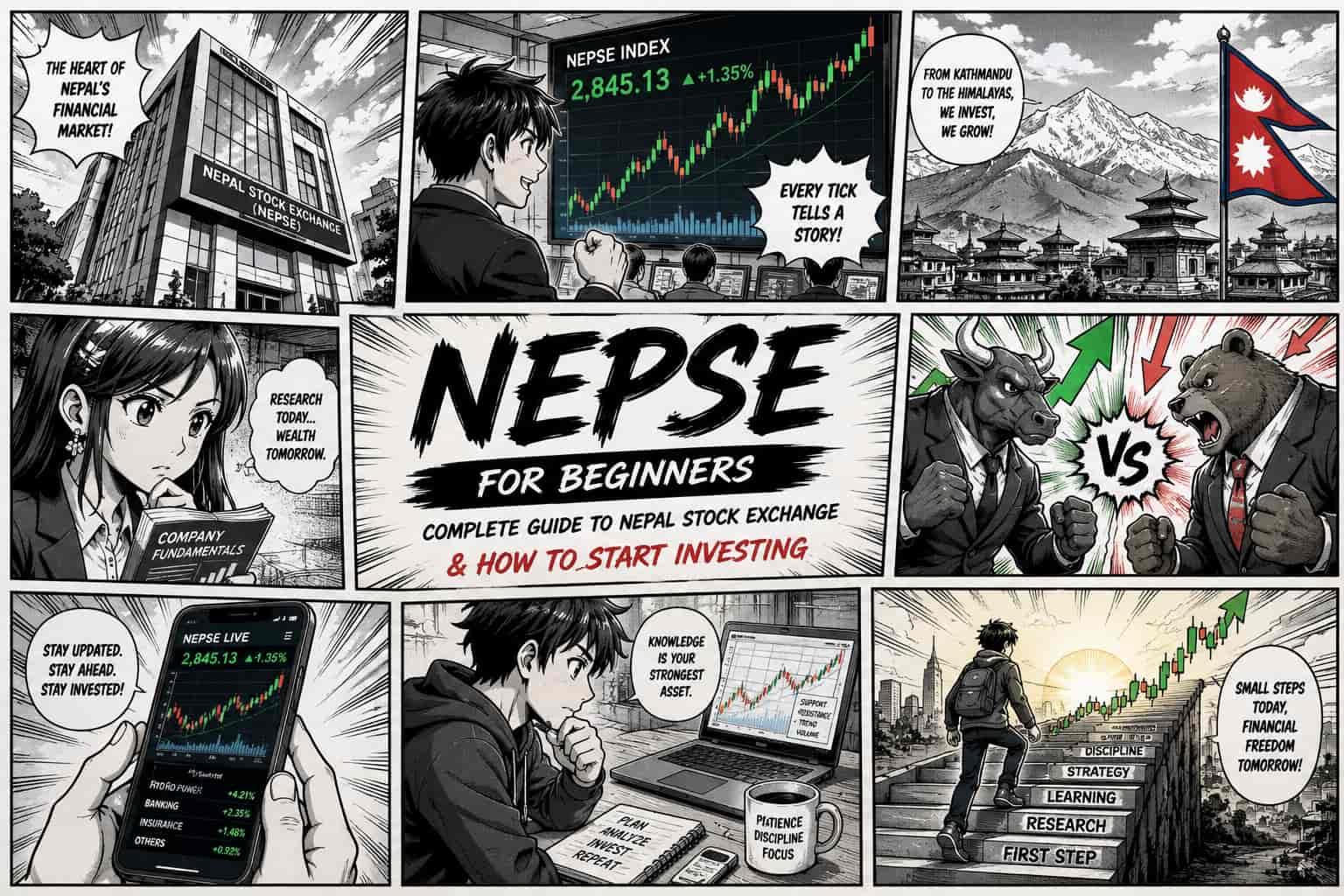
Why Everyone Is Talking About NEPSE
Imagine sitting in a tea shop in Kathmandu and overhearing a conversation about the NEPSE Index rising 50 points overnight. A few years ago, that conversation might have been limited to bankers and finance professionals. Today, it includes teachers, students, entrepreneurs, and homemakers. Nepal’s stock market revolution is real — and it is just getting started.
The Nepal Stock Exchange, commonly known as NEPSE, has witnessed an extraordinary surge in retail investor participation over the last decade. Searches for “NEPSE Today,” “NEPSE Live,” and “NEPSE Alpha” have skyrocketed, reflecting a growing hunger for financial literacy and investment opportunity. People from every walk of life are asking the same question: How do I get started in the Nepal stock market?
This comprehensive beginner’s guide answers that question. Whether you are a complete newcomer or someone looking to deepen their understanding, this guide will walk you through everything — from what NEPSE is, how the NEPSE Index works, how to track NEPSE Live prices, how to read the NEPSE Floor Sheet and NEPSE Chart, how to use NEPSE Alpha, and finally, how to place your very first trade with confidence.
Understanding the Nepal Stock Exchange
History and Overview
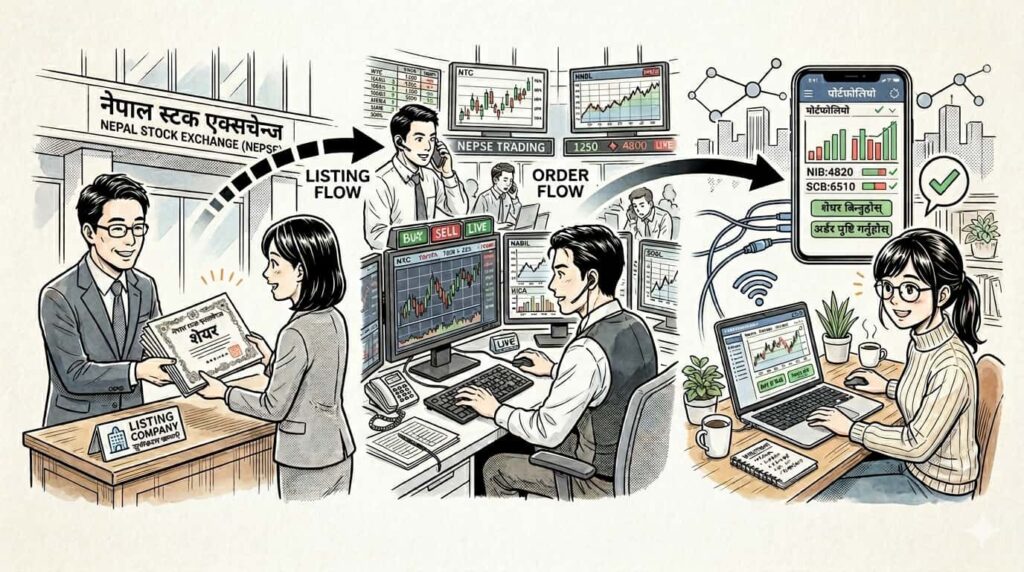
The Nepal Stock Exchange (NEPSE) was established in 1993 under the Securities Exchange Act of 1983. It is the only stock exchange in Nepal, operating as a non-profit organization under the oversight of the Securities Board of Nepal (SEBON). What began as a modest marketplace for trading company shares has transformed into a fully digitized trading ecosystem that handles billions of rupees in transactions every trading day.
NEPSE plays a central role in Nepal’s economy. It provides companies with access to public capital, gives investors a platform to grow their wealth, and serves as a barometer of economic health and investor sentiment. The digital trading evolution from open-outcry floor trading to the current online TMS (Trading Management System) has made NEPSE Today data accessible to anyone with a smartphone.
How NEPSE Works
NEPSE operates as a marketplace where buyers and sellers of securities stocks, debentures, and government bonds — come together. The key players in this ecosystem are:
- Investors (Buyers & Sellers): Individuals and institutions who trade securities.
- Licensed Brokers: Registered intermediaries who execute trades on behalf of investors through NEPSE’s TMS platform.
- Securities Board of Nepal (SEBON): The regulatory authority that frames policies, grants licenses, and protects investor interests.
- CDS & Clearing Ltd. (CDSC): Manages the Central Depository System, ensuring secure electronic storage of securities (DEMAT accounts) and smooth settlement of trades.
Types of Companies Listed on NEPSE
- Manufacturing & Hotels: Companies in production, hospitality, and consumer goods.
- Banks & Financial Institutions (BFIs): Commercial banks, development banks, finance companies, and microfinance institutions.
- Hydropower Companies: A rapidly growing sector fueled by Nepal’s abundant water resources.
- Insurance Companies: Life and non-life insurers listed on NEPSE Today.
What is the NEPSE Index?
Definition and Purpose
The NEPSE Index is the benchmark index of the Nepal Stock Exchange. It measures the overall performance of the stock market by tracking the market capitalization of all listed companies. Think of the NEPSE Index as the pulse of Nepal’s capital market when it rises, market sentiment is generally positive; when it falls, investors exercise caution.
Every NEPSE Today report leads with the NEPSE Index figure, because it instantly tells investors whether the market moved up, down, or stayed flat compared to the previous trading session.
Why Investors Watch the NEPSE Index Daily
- Market Sentiment Indicator: A rising NEPSE Index reflects bullish confidence; a falling index signals bearish pressure.
- Bull vs Bear Market Signals: Sustained uptrends indicate a bull market; sustained downtrends indicate a bear market. Understanding these cycles is essential for strategic investing.
- Investor Confidence: The NEPSE Index influences how much money flows into or out of the market, affecting liquidity and stock prices.
Factors That Move the NEPSE Index
- Political Stability: A stable political environment encourages foreign and domestic investment, positively affecting NEPSE Today figures.
- Interest Rates: When interest rates fall, borrowing becomes cheaper, businesses expand, and stock prices typically rise and vice versa.
- Government Policies: Budgets, fiscal policies, and infrastructure investments significantly impact listed sectors.
- Hydropower & Banking Performance: These two dominant sectors heavily influence overall NEPSE Index movements.
NEPSE Live: How to Track the Market in Real Time

What is NEPSE Live?
NEPSE Live refers to real-time stock price tracking during market hours Monday through Friday, from 11:00 AM to 3:00 PM Nepal Standard Time. For active traders and serious investors, NEPSE Live data is not optional; it is the lifeblood of informed decision-making. Every tick in the price of a stock during market hours is captured in real-time through NEPSE Live platforms.
Platforms to Track NEPSE Live
- Official NEPSE Website (nepse.com.np): Provides the official NEPSE Live index and individual stock prices.
- NEPSE Alpha (nepsealpha.com): The most popular third-party platform for NEPSE Live data, charts, and analytics. Discussed in detail in Section 11.
- Broker Trading Apps (TMS Portals): Licensed brokers offer their own portals where you can view NEPSE Live prices and place trades simultaneously.
Why Real-Time Data Matters
- Intraday Trading Decisions: Traders who buy and sell within a single session rely entirely on NEPSE Live updates.
- Market Momentum Tracking: Real-time data helps identify when a stock is gaining or losing momentum.
- Avoiding Delayed Decisions: Acting on delayed data can mean buying at a peak or selling at a trough — both costly mistakes.
Understanding the NEPSE Floor Sheet
What is the NEPSE Floor Sheet?
The NEPSE Floor Sheet is a comprehensive record of every transaction that took place on the Nepal Stock Exchange on a given trading day. It reveals the complete picture of market activity — which stocks were traded, at what prices, in what quantities, and crucially, which brokers were on the buying and selling sides.
The NEPSE Floor Sheet is publicly available after market close each day and is one of the most powerful yet underused tools for beginner investors. Analyzing it consistently can reveal patterns that give you a genuine edge in the Nepal stock market.
How to Read the NEPSE Floor Sheet
- Volume Insights: High-volume days with rising prices confirm strong buyer interest; high volume with falling prices signals distribution by sellers.
- Buyer Broker vs Seller Broker: Each transaction shows the broker codes of both the buyer and seller. Tracking which institutional brokers are consistently buying a stock signals potential accumulation.
- Quantity Traded: Large volume traded by a single broker in one direction (buying or selling) provides clues about smart money movements.
- Price Range: Observing the range of prices at which a stock traded helps identify support (the lowest price buyers defended) and resistance (the highest price sellers emerged) levels.
How to Read NEPSE Charts (Technical Analysis Basics)

Why NEPSE Charts Matter
A NEPSE Chart is a visual representation of a stock’s price history over time. Charts allow investors to identify patterns, trends, and potential turning points that are invisible in raw numbers. While fundamental analysis tells you WHAT to buy (a company’s quality and value), technical analysis via NEPSE charts tells you WHEN to buy and sell.
Basic Chart Types
- Line Chart: Plots only the closing price over time. Simple, clean, and ideal for a quick snapshot of overall trend direction.
- Candlestick Chart (Most Important): Each ‘candle’ shows the open, high, low, and close price for a given period. Green/white candles indicate a bullish session (close above open); red/black candles indicate a bearish session. Candlestick charts are the industry standard for technical analysis.
- Bar Chart: Similar to a candlestick but displayed as vertical bars. Less commonly used by beginners but carries the same price information.
Key Technical Indicators Beginners Should Learn
- Support & Resistance: Support is a price level where buying interest is strong enough to prevent further decline. Resistance is a ceiling where selling pressure prevents further rise. These are the two most fundamental concepts in NEPSE chart reading.
- Moving Averages (MA): A moving average smoothens price data into a single flowing line. The 20-day and 50-day MAs are widely watched by NEPSE traders. When the price crosses above the MA, it is a bullish signal; below is bearish.
- Volume Analysis: Volume confirms price moves. A breakout above resistance with high volume is far more reliable than the same breakout on low volume.
- Trendlines: Drawn by connecting a series of highs (downtrend) or lows (uptrend), trendlines help visualize the prevailing direction and identify when a trend may be reversing.
NEPSE Alpha offers the best NEPSE Chart tools for Nepali investors, complete with candlestick charts, overlaid indicators, and historical data comparison features — all in one convenient platform.
Step-by-Step: How to Start Investing in NEPSE
Step 1: Open a DEMAT Account
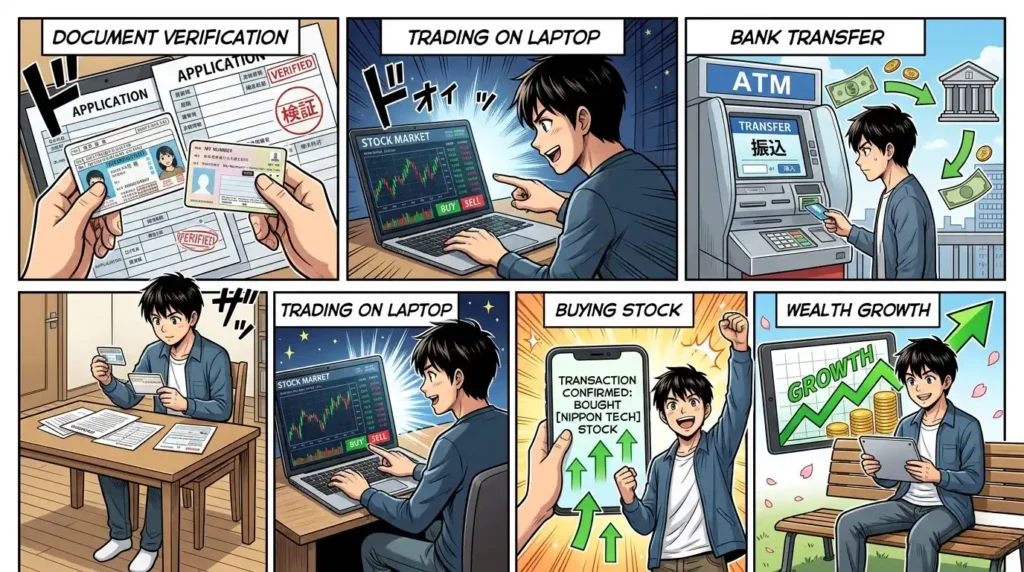
A DEMAT (Dematerialized) Account is your electronic wallet for holding shares. Without it, you cannot legally hold shares on the Nepal Stock Exchange. Opening one is free through CDSC-registered Depository Participants (typically banks or brokers).
Documents Required:
- Nepali citizenship certificate
- Active bank account (with the same name)
- Passport-size photograph
- Email address and mobile number for verification
Step 2: Open a TMS Trading Account
The TMS (Trading Management System) account is your online interface to actually buy and sell stocks on NEPSE. You open it through a SEBON-licensed broker. Nepal has over 50 licensed brokers — choose one based on reputation, customer service, and the quality of their online trading platform. Once your TMS account is activated, you can access NEPSE Live prices and place orders from your computer or smartphone.
Step 3: Link Your Bank Account
Connect your bank account to your trading account to facilitate seamless fund transfers. Most brokers work with Nepal’s major commercial banks. When you want to buy shares, funds are transferred from your bank into the trading account. When you sell, the proceeds return to your bank account.
Step 4: Learn to Place Your First Trade
- Buy Order: You specify the stock, quantity, and maximum price you are willing to pay.
- Sell Order: You specify the stock, quantity, and minimum price you want to receive.
- Limit Order: Your trade executes only at your specified price or better. This is the standard order type in NEPSE.
- Market Order: Your trade executes immediately at the best available current price.
Step 5: Start Small and Learn Continuously
The golden rule for every beginner in the Nepal stock market is this: invest only what you can afford to lose while learning. Start with a small amount of NPR 5,000 to NPR 10,000 in one or two fundamentally sound companies. As you gain experience reading NEPSE Today data, NEPSE charts, and the NEPSE Floor Sheet, gradually increase your investment.
Types of Investors in NEPSE

Long-Term Investors (Buy and Hold)
Long-term investors buy fundamentally strong stocks and hold them for years, sometimes decades. Their focus is on the company’s earnings growth, dividend income, and increasing book value over time. This strategy requires the least active monitoring periodic review of NEPSE Today data and annual reports is sufficient. It is the lowest-risk approach for most beginners.
Swing Traders
Swing traders hold stocks for days to weeks, aiming to capture medium-term price movements. They rely heavily on NEPSE Chart analysis identifying support and resistance levels, breakout patterns, and trend reversals to time their entries and exits. Swing trading requires moderate experience with technical analysis.
Intraday Traders
Intraday traders buy and sell within the same trading session, relying entirely on NEPSE Live real-time data to capture small price movements for quick profits. This is the highest-risk form of trading and is not recommended for beginners. Successful intraday trading requires deep market knowledge, strong emotional discipline, and sophisticated use of NEPSE charts and indicators.
Which Strategy Is Best for Beginners?
For most beginners entering the Nepal stock market, long-term investing in fundamentally strong companies in the banking and hydropower sectors offers the best combination of growth potential and manageable risk. Master the basics first, then gradually explore swing trading as your experience grows.
Best Sectors for Beginners in the Nepal Stock Market
Banking Sector
Nepal’s banking sector is the backbone of NEPSE and the most-watched sector in NEPSE Today reports. Commercial banks are tightly regulated by Nepal Rastra Bank, providing a layer of safety. They regularly distribute dividends (both cash and bonus shares), making them ideal for long-term, income-focused investors. Their stocks are generally more liquid than other sectors, meaning you can buy and sell them more easily.
Hydropower Sector
Nepal possesses the second-largest hydropower potential in the world, and yet only a fraction of it has been harnessed. The hydropower sector in NEPSE represents enormous long-term growth potential. As Nepal generates more electricity, sells it to neighboring countries, and meets domestic demand, hydropower companies are expected to deliver strong earnings growth. Patient investors who buy and hold quality hydropower stocks stand to benefit significantly over the next decade.
Insurance Sector
Insurance stocks on NEPSE tend to be more volatile than banking stocks but offer higher short-term trading opportunities for those who follow NEPSE Live prices and charts carefully. Nepal’s insurance penetration rate remains low by international standards, suggesting significant room for growth as the economy develops and public awareness increases.
Diversification Strategy
A sound beginner portfolio in the Nepal stock market might include 50% banking sector stocks, 30% hydropower stocks, and 20% insurance or manufacturing stocks. This diversification ensures that weakness in one sector does not devastate your entire portfolio. Regularly review your NEPSE Today data and rebalance as needed.
Common Beginner Mistakes in NEPSE (And How to Avoid Them)
1. Emotional Trading
The most expensive mistake in any stock market is letting fear and greed drive your decisions. When the NEPSE Index falls sharply, fear pushes beginners to sell perfectly good stocks at a loss. When it rises, greed pushes them to buy overpriced stocks at their peak. Stick to your investment plan. Markets go up and down — disciplined investors profit from this; emotional traders do not.
2. Following Rumors and Tips
“Buy NABIL — I heard it’s going to 2,000!” Rumors are the downfall of many NEPSE beginners. Always base investment decisions on research: company financials, NEPSE Today data, sector trends, and verified news — never on unverified social media tips or tea-shop gossip.
3. Ignoring Research and Fundamentals
Buying a stock simply because its price has been going up is not investing — it is speculating. Before buying any stock on NEPSE, review its earnings per share (EPS), price-to-earnings ratio (P/E), return on equity (ROE), and recent dividend history. NEPSE Alpha provides easy access to this fundamental data.
4. Overtrading
Every trade on NEPSE incurs broker commission and government taxes (capital gains tax, securities transaction tax). Frequent buying and selling eats into your profits — and magnifies your losses. Less is more in the Nepal stock market. Make fewer, better-researched trades.
5. Lack of Patience
Wealth in the stock market is built over years and decades, not weeks. The Nepal stock market has delivered outstanding long-term returns to patient investors. Track your NEPSE Index trends over months and years — not just NEPSE Today’s single-day movement — to maintain perspective and stay the course.
Tips to Become a Smart NEPSE Investor
Learn Before You Invest (Paper Trading)
Before committing real money, practice with hypothetical trades. Open a notebook, write down which stocks you would buy and at what price, and track how they perform over the next few months using NEPSE Today data. This ‘paper trading’ approach builds your analytical muscle without financial risk.
Follow Market News Every Day
Read financial news from Sharesansar, Mero Lagani, and NEPSE Alpha daily. Understanding the stories behind NEPSE Today movements — why did a bank’s stock drop today? Why did a hydropower company surge? — deepens your market intuition over time. Connect macroeconomic events (interest rate changes, government budgets, monsoon forecasts) to their impact on the NEPSE Index.
Master NEPSE Alpha Tools
NEPSE Alpha (nepsealpha.com) is the most comprehensive analytics platform for Nepali investors. It offers NEPSE Live price tracking, advanced NEPSE charts with technical indicators, fundamental financial data for all listed companies, NEPSE Floor Sheet analysis tools, portfolio trackers, and IPO application features. Spending 20–30 minutes daily on NEPSE Alpha will accelerate your investment education dramatically.
Track NEPSE Index Trends Over Time
Keep a personal journal of the NEPSE Index level at the end of each week. Note major events that influenced market movement. Over time, you will begin to see patterns: how the market responds to Nepal Rastra Bank policy announcements, how budget day affects banking stocks, how the monsoon forecast impacts hydropower sectors. This pattern recognition is invaluable for long-term success.
Think Long Term — Always
The most successful investors in Nepal’s stock market have been those who bought quality companies and gave them time to grow. Short-term market noise is inevitable — the NEPSE Index will have corrections and bear markets. Long-term investors see these as buying opportunities, not catastrophes. Your greatest advantage as an individual investor is patience.
The Future of NEPSE and Investment Opportunities

Nepal’s capital market is on an undeniable growth trajectory. Digital trading infrastructure is improving rapidly, making NEPSE Live data and NEPSE Alpha tools more accessible than ever. Retail investor participation is surging, with hundreds of thousands of new DEMAT accounts being opened each year. This democratization of investing is a defining trend of Nepal’s economic development.
The hydropower sector represents perhaps the single largest investment opportunity in Nepal’s history. With dozens of large hydropower projects under construction and electricity export agreements with India in progress, the pipeline of value creation for long-term NEPSE investors is extraordinary.
As Nepal’s economy grows, financial literacy improves, and digital access expands, the Nepal Stock Exchange is poised to become one of South Asia’s most dynamic frontier markets. The investors who educate themselves today learning to read NEPSE charts, analyze the NEPSE Floor Sheet, track NEPSE Live data, and use NEPSE Alpha will be best positioned to benefit from this exciting future.
Conclusion: Your Investment Journey Starts Today
You have just completed a comprehensive journey through the fundamentals of Nepal’s stock market. From understanding what NEPSE is and how the NEPSE Index works, to tracking NEPSE Live prices, analyzing the NEPSE Floor Sheet, reading NEPSE charts, and using NEPSE Alpha as your analytical command center you now possess the foundational knowledge that most Nepali investors never take the time to acquire.
Remember that investing is a lifelong journey, not a get-rich-quick scheme. The Nepal stock market has rewarded patient, disciplined, and informed investors consistently over the long term. Start small. Learn continuously. Use the right tools. Think in years, not weeks.
Open your DEMAT account this week. Spend time on NEPSE Alpha today. Read NEPSE Today data every morning. Study one NEPSE chart every evening. These small, daily habits compound into extraordinary investment outcomes over time.
What is NEPSE Today?
NEPSE Today refers to the daily performance snapshot of the Nepal Stock Exchange, including the NEPSE Index level, top gaining and losing stocks, total market turnover, and overall trading volume for the session.
How can beginners invest in NEPSE?
Open a DEMAT account through a CDSC-registered institution, then open a TMS trading account with a licensed broker, connect your bank account, deposit funds, research stocks using NEPSE Alpha and NEPSE Today data, and start with a small initial investment in a fundamentally sound company.
Where can I see NEPSE Live trading?
You can track NEPSE Live prices on the official NEPSE website (nepse.com.np), through NEPSE Alpha (nepsealpha.com), and through your licensed broker’s TMS trading portal during market hours (Sunday–Thursday, 11:00 AM–3:00 PM NST).
What is the NEPSE Floor Sheet?
The NEPSE Floor Sheet is the official daily transaction record showing every trade executed on the Nepal Stock Exchange — including the buyer broker, seller broker, quantity traded, and price. It is a powerful tool for tracking institutional activity and smart money movements.
Is NEPSE good for beginners?
Yes, NEPSE offers excellent long-term growth opportunities for disciplined, patient investors. The key is starting with solid research, beginning with small investments in stable sectors like banking and hydropower, and continuously educating yourself using resources like NEPSE Alpha and NEPSE Today reports.
How much money do I need to start investing in Nepal?
You can begin investing in the Nepal stock market with as little as NPR 1,000 to NPR 5,000. Since most stocks trade in ‘kitta’ (unit) quantities, even small amounts allow you to purchase shares in quality companies and start building your investment portfolio.
Which sector is best in NEPSE?
For beginners, the Banking, Hydropower, and Insurance sectors are the most accessible. Banking stocks offer stability, regular dividends, and high liquidity. Hydropower stocks offer outstanding long-term growth potential. Insurance stocks offer higher volatility with greater short-term trading opportunities for more experienced investors.


Leave a Reply